Healthy Life Expectancy Is Falling in the UK: Why It Matters More Than Ever
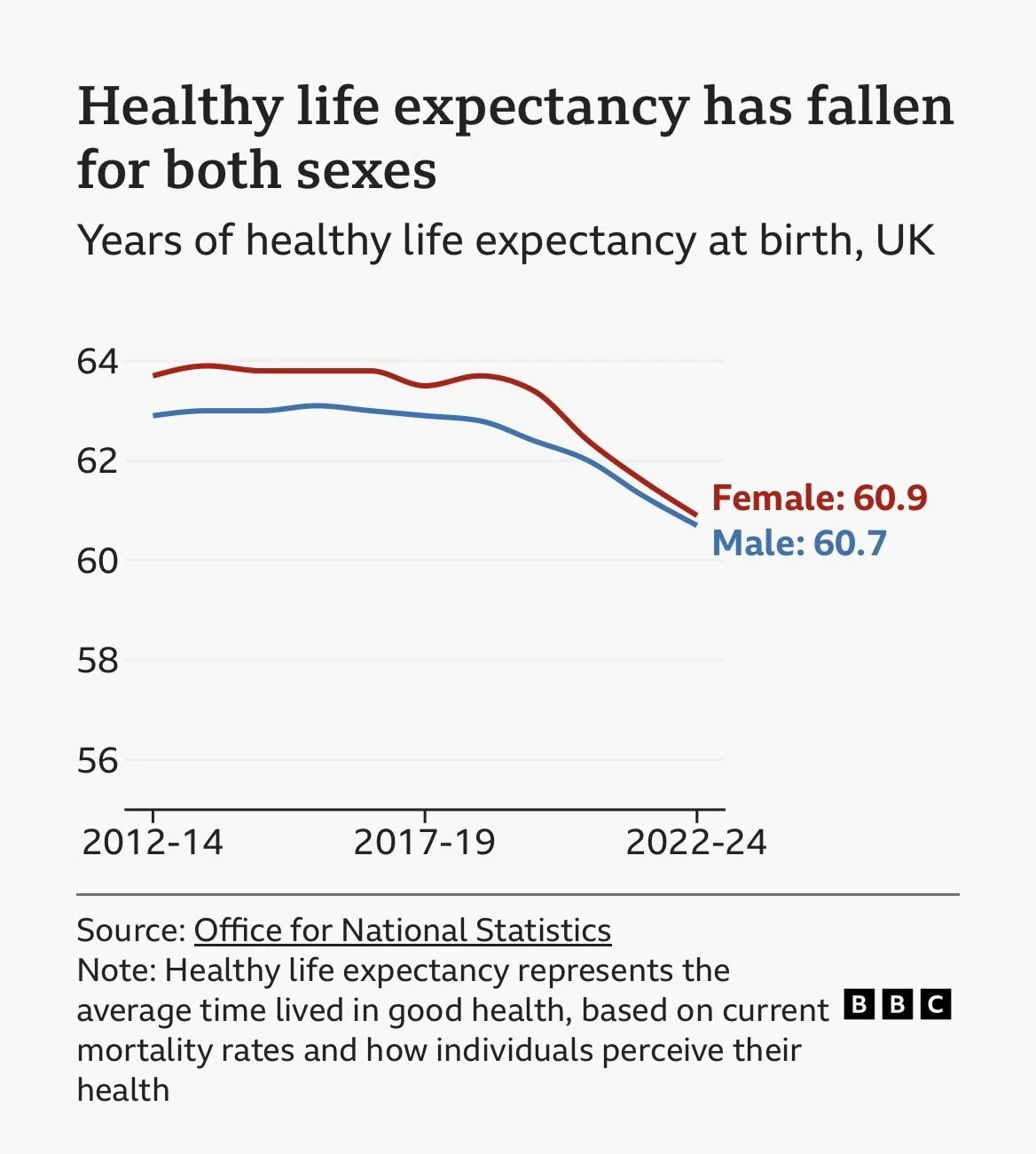
Recent data has revealed a concerning shift in the UK’s health landscape. While people are living longer, they are not necessarily living better. Healthy Life Expectancy, often shortened to HLE, has fallen to around 61 years in the UK. This means the average person can now expect to spend nearly two decades of their life in poor health.
This is not just a statistic. It is a wake up call.
What Is Healthy Life Expectancy and Why Should You Care?
Healthy Life Expectancy measures how many years you are likely to live in good health, free from serious illness or disability. Unlike standard life expectancy, which simply measures how long you live, HLE focuses on quality of life. It reflects how many of those years are lived with energy, independence, and wellbeing. Currently, UK life expectancy sits at around 79 years for men and 83 years for women. But if healthy life expectancy is just 61 years, there is a growing gap between how long we live and how well we live. That gap is where many people experience chronic illness, reduced mobility, stress, anxiety, and dependence on medication.
The UK Is Moving in the Wrong Direction
In many comparable countries, healthy life expectancy is improving. In the UK, it is declining. Data shows that HLE has dropped by around two years over the past decade, reaching its lowest level since records began. Even more concerning is the inequality. People in wealthier areas can expect to live up to 20 years longer in good health than those in more deprived regions. This highlights a crucial truth. Health is not just about genetics. It is strongly influenced by lifestyle, environment, and behaviour.
What Is Driving the Decline?
Several key factors are contributing to this drop in healthy life expectancy:
Poor diet and rising obesity
Lack of physical activity
Chronic stress and mental health challenges
Many of these are modifiable lifestyle factors. That means they can be changed. Research consistently shows that conditions such as heart disease, type 2 diabetes, and anxiety disorders are closely linked to behaviour patterns and daily habits. The issue is not a lack of information. Most people already know what they “should” be doing. The real challenge is making change stick.
The Hidden Problem: Knowing vs Doing
There is a gap between awareness and action. People often understand the risks of smoking, overeating, or chronic stress. Yet they still find themselves repeating the same behaviours. Why? Because behaviour is not just logical. It is emotional, habitual, and often unconscious. This is where many traditional approaches fall short. They focus on willpower, discipline, and surface level change. But lasting change requires something deeper.
Why Behaviour Change Is the Key to Extending Your Healthy Life
If healthy life expectancy is declining, the most powerful intervention is not simply medical treatment. It is behaviour change. Small, consistent changes in daily habits can dramatically extend the number of years you live in good health.
This includes:
Eating in a way that supports long term health
Managing stress effectively
Sleeping well
Eliminating harmful habits like smoking or vaping
Developing a healthier relationship with food and self
However, these changes need to be sustainable. Short term motivation is not enough. What matters is long term, lasting change.
How OLIP Helps You Extend Your Healthy Life Expectancy
At OLIP Therapy, the focus is not just on temporary results. It is on effective, lasting change. Our approach combines evidence based techniques such as hypnotherapy, counselling, CBT, and EMDR to help address the root causes of behaviour, not just the symptoms. This means you are not relying on willpower alone. You are working with your mind, not against it.
Through this process, clients can:
Achieve sustainable weight loss
Stop smoking or vaping for good
Reduce stress and anxiety
Improve sleep quality
Build healthier habits that last
Ultimately, extending your healthy life expectancy is not about adding years to your life. It is about adding life to your years.
And that starts with change that actually sticks. Contact OLIP Therapy today and start living the life you want and deserve.